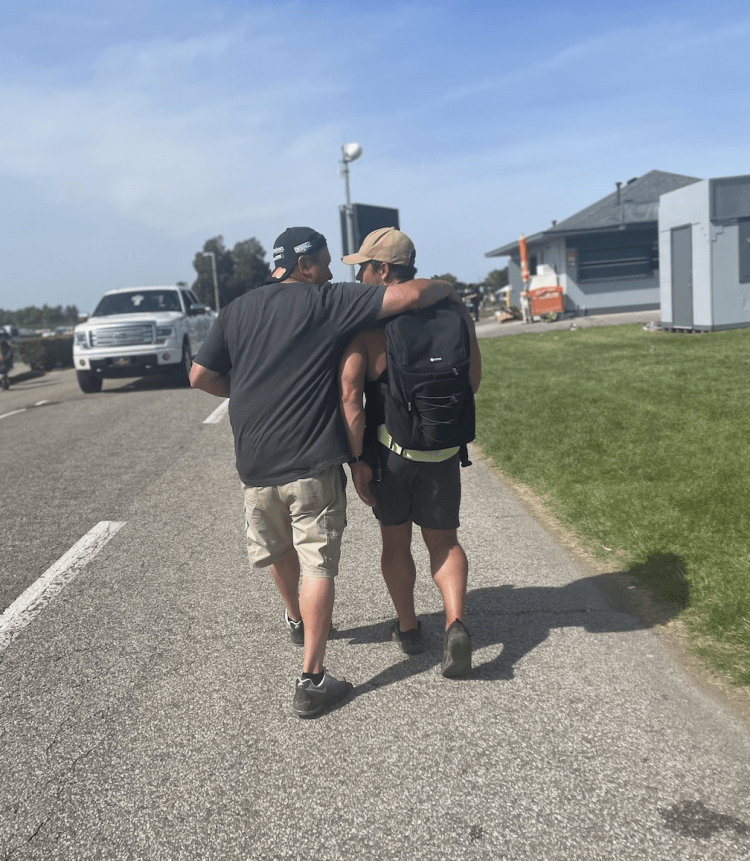
As many of you know, my father passed away on May 3rd, 2026.
Since that day, my life has not been the same in any way, shape, or form.
And by just the sheer amount of people who have reached out to me and my family, it is obvious that many people feel the same way.
During this time, my whole world has been rocked. One of the main people in my life that I looked at for support, love, and reassurance and the person I wanted to make proud was no longer here – and I’ve been trying to figure out how to carry on with that.
Throughout that journey, throughout that experience, one of the things that I’ve attempted to proactively do is go and get tested for different cardiovascular health risks that I might be associated with.
The reason I did that is because I looked at the history of my family and saw a lot of issues with heart attacks and coronary disease. My dad, both grandpa’s, my uncle last year…all taken from us far too early due to some complications with the heart.
And so I ambitiously set out to identify my risks.
What I didn’t realize was that the results of those tests would continue to change my life and add to the stress, weight, and sadness the passing of my father brought, and, in many ways, change the course of my life.
Naively, I thought that while, yes, there was repeated family history, for some reason it would not hurt me.
We all think that, right? That while others can experience risks and issues, we surely can’t – right?
Well, the test results started rolling in and they told a massively different story.
So before digging into the results and what I’ve learned – you might be asking, why is Eddie writing this?
Well, part of this is therapeutic and getting it on paper gets it out of my head.
But the primary reason I’m writing this is because, first and foremost, I wish I would have known about some of this 15 years ago.
Secondly, I wish my dad would have known all this and I wish I was more educated in this area to be able to help him while he was here.
And thirdly, I’m sharing it because I’m happy that I know it now, despite the anxiety, despite the concerns, and despite the weight of some of the findings. I’m digging myself out of the deep hole of despair with more knowledge, more solutions, and more hope for the future.
Up to this point, my life has massively been improved through learning from others who have been willing to outwardly speak about the struggles and challenges they’re dealing with.
I figured this was an opportunity for me to do the same.
With that being said, here’s a little bit about the findings and what I’ve learned through the process.
Wake Up Call 1: Fit Does Not Mean Healthy
The number one thing I’ve learned is that being fit does not necessarily mean that you are healthy.
I’ve spent the majority of my life working out, at times to the extreme. Marathons, big lifts in the 400 pounds, crossfit, you name a type of activity or exercise, and I could do it.
And while I’m far from perfect, I would say that I eat better than average, at least compared to the ‘average’ American.
I’ve prided myself on being physically active, being physically strong, and being physically fit. I’ve put a lot of my identity into those things.
Growing up, you’re told that by doing those things, you are healthy. That those are the healthy choices.
The mistake I made was not realizing that health is a much bigger equation.
There are some things you can’t outrun. You can’t outlift them. You can’t out-eat them.
Those things are genetics. It’s the predisposition you have to certain risk factors.
And you can only identify some of those things through blood tests, scans, and routine check-ins with medical professionals.
I embarked on a health journey in May of this year, and after giving my primary care physician the history of cardiovascular disease in my family, he sent me on a journey to get additional testing.
That testing identified, first, a massive genetic risk factor for cardiovascular disease: lipoprotein(a), or Lp(a).
My reading was 255 nmol/L. A commonly used high-risk threshold is 125 nmol/L, meaning mine was roughly twice that level.
Lp(a) is overwhelmingly genetic. It is not something that can simply be fixed by eating better or exercising more. There are medications being studied and a lot of innovation happening in this area that seems incredibly promising, but today it is a risk factor that can only be understood and accounted for.
If you were to ask me before this reading if I’m predisposed to heart issues, I would say “of course…”
But this number made it real. This reading made it go from ‘yeah but I run I should be fine’ to ‘this is much more serious than I thought…and it’s real.’
Then came more standard readings like LDL cholesterol and ApoB, which were also much higher than the levels being recommended for me given my risk profile.
Those can be changed through lifestyle and medication, but in my situation, eating incredibly well, not drinking, not smoking, remaining active, it was still mind-blowing to see elevated levels in the 2x range of normal.
LDL and ApoB are connected to the particles involved in the development of plaque inside your arteries. And as I talked through this with my doctor, he explained something similar to what I had learned about Lp(a): at some point, genetics can simply give you a different baseline.
Sometimes your baseline is not “normal,” no matter how many miles you run, the diet you have, or the lifestyle you live.
But the biggest finding, and easily the scariest finding, was the one that changed my perspective on everything.
I received a positive coronary artery calcium scan.
Going into the heart scan itself, the way it was framed to me beforehand by my PCP was basically: There’s a very low chance you’ll have any calcified plaque at 33 years old, but with your family history, we want to establish a baseline and make sure.
So I went in, received the scan, and eventually got my results.
My coronary artery calcium score was 30.
I don’t think I’ve felt that hopeless and that shocked in my entire life. At the time, I was expecting 0. I was expecting to get some sense of reassurance that I was going to be ok, only to be told otherwise. And it shook me to my core.
For someone my age, that placed me at an extremely high percentile (99th) compared with my peers.
Long story short: finding any measurable coronary calcium at 33 is extremely uncommon.
Coronary calcium represents calcified plaque inside the coronary arteries. It is evidence that the process of atherosclerosis (heart disease) has already begun and. Calcified plaque takes decades to form in some cases.
And at 33 years old, I had proof that cardiovascular disease had already started to take its grip on me.
That reading, alongside everything else, completely shattered a part of my identity.
It shattered the way I looked at the future.
And it scared the living hell out of me.
It sent me down many, many spirals about longevity, mortality, and anything else you can think of when you suddenly begin questioning how much life might be in front of you.
Coming off the heel of my father passing and the emotions I was feeling from that, it was unbearable in a lot of ways.
As I already mentioned but I mentioned it again because of how real it was, my entire life has changed in how I view health, myself, my identity and the future.
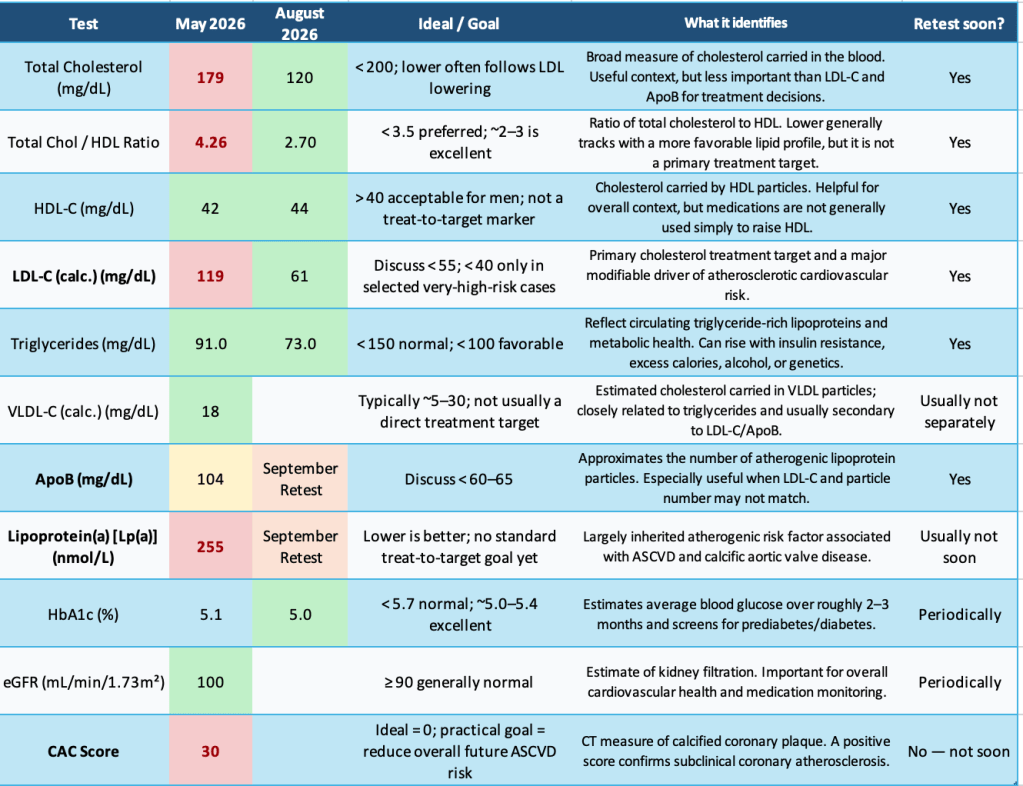
My full results and what I plan to get tested again in September. Based on these results, will discuss with lipidologist the goals for LDL, ApoB, Lp(a) based on my specific risk profile.
Summary: Positive signs thus far in improving LDL, Chol / HDL ratio while maintaining all kidney and liver function and no side effects from statin use. Note: while lp(a) is genetic, will get retested as statins can increase lp(a) readings.
So to recap, father passed of heart issues. Then about 2 weeks after I start to recieve abnormal cardiovascular risk reading after abnormal reading. Risk after risk.
The toll that began to take on me and is still taking on me was too much at times.
“Will I be ok? How long will I be here? Should I start preparing my affairs? Will I be around much longer? Is there any hope?” → All questions populating my mind.
But through those questions, through education, and through time, there is hope and there are solutions.
Knowing the Risk
I have spent many days and nights researching.
I have talked to cardiologists.
I have talked to lipidologists.
I have talked to ChatGPT (I hope those chats with AI never get leaked LOL)
I have read studies. I have asked questions. I have looked for reassurance. I have looked for answers.
And the overall story is actually pretty clear.
These findings are associated with one another, and they put me in a higher-risk category for cardiovascular disease than I ever imagined I would be at 33 years old. That’s the truth.
But that does not mean the story is already written.
That distinction has taken me months to understand. Still taking me time to understand.
Because when you receive information like this immediately after losing your father, and while still remembering the loss of my uncle last year, it becomes very difficult to separate risk from destiny.
For the last three or four months, I have lived in a state of fear around this information. Paralyzing fear. The child in me wants to be hugged and told everything is ok. You’ll live a long life as an old man. You’ll be just fine and healthy… but that’s not reality. Even without these risk factors, tomorrow isn’t promised in any situation for anyone.
But through the help of so many people, through time, education, and conversations with professionals who live in this world every day, I have started to turn that fear into something different.
Yes, I am at elevated risk for cardiovascular disease. That’s scary.
But what’s scarier is the thought of these risks going unseen and untreated for years to come. Not knowing might have felt better these past few weeks, but they would have been far worse realizing them later on in life, or not at all.
There are also proven steps that can be taken to reduce as much of that risk as possible through medication, lifestyle, monitoring, and prevention.
By no means am I saying any of this as medical advice that someone else should take. I think everybody should learn as much as they can about their own health, talk with medical professionals, understand the options available to them, and make the decisions that are best for their individual situation and them.
But for me, that has meant starting a statin, which lowered my LDL cholesterol by roughly 50%. Huge win.
It means continuing to get blood work and monitoring my numbers. Next appointment in September.
It means following the incredible amount of research happening around Lp(a) and the medications currently being studied to lower it. Big news coming out in the coming months.
It means massively improving the way that I eat.
I’m living much closer to a Mediterranean diet now. Fish has become a staple. There are a lot more vegetables, fruit, fiber, whole foods, and very little red meat. Actually can feel the difference and beginning to get my body composition into a place I feel great about – been trying to for years!
It means continuing to exercise, doing more intentional cardiovascular work, attempting to lose some weight, continuing not to drink, continuing not to smoke, and doing everything reasonably within my control to stack the odds in my favor.
It means monitoring my blood pressure at home. Ensuring I track that on a weekly basis to ensure I’m controlling the controllables.
Most importantly, it means having a support system around me.
Primary care doctors. Cardiologists. Lipid specialists. People who understand this and live in this world every day.
And it means learning to trust that the purpose of identifying these risks early is not to predict an ending.
It is to change one.
What started as a feeling of ‘my destiny is written’ has continued to evolve into a feeling of ‘I’m altering my destiny as much as I can.’
Others unfortunately get diagnosed with health issues that they can’t control and that does write their destiny. I am blessed to have choices and solutions in front of me and for that I’m grateful.
As I sit here four months later and look at where I’ve been over the last couple of months, I believe my life will ultimately be better because I learned all of this.
My life will be improved because I know.
That doesn’t change the fact that it has been one of the scariest experiences of my life.
Because as I sat with all of this, my mind became stuck on one thing:
Mortality.
As I said previously the continued thought for months was ‘how long will I be here?’
But as I think about the teachings of my dad, and as I look back at everything surrounding his life and his death, I’m beginning to realize something else.
The real questions driving that fear felt were less around the risks, and more about the time I’ve had thus far.
‘ Has this life I’ve lived so far enough? Am I doing what I’m meant to do here with the time I have? Time is not guaranteed, am I making the most of it?’
So instead of dwelling on the time here so much, i started to focus on making the most of the life I get.
And with that, the most important wake up call has happened as of late.
Wake Up Call 2: The Art of Living
I always knew we were going to die.
I never really believed it until now.
When you face mortality as head-on as my family and I have over the last year, there are a lot of ways you can react to it. There are a lot of directions your mind can take.
As I’ve shared already, as I learned about the elevated risks that I have, and as I thought about what that could mean for my life, I became a scared little boy hiding in the shadows, waiting for someone to tell me that everything was going to be okay.
I have spent countless hours trying to figure out how to remain on this earth for as long as humanly possible.
And while that is insanely important, while taking care of yourself, understanding your risks, going to the doctor, taking your medication, eating well, exercising, and doing everything within your control absolutely matters, there is another side of this that I almost completely forgot.
The art of living. Something my father taught me well.
The art of making the most of your time here.
The art of living a life where people want to be around you – and where you want to be around yourself.
A life where you laugh. A life where you cry.
Where you don’t take yourself so seriously.
Where you can bring some light into a dark situation.
Where people know they can count on you.
Where you love people hard.
Where you show up.
Where you dive into the moment at hand, live in the present, and forgo thoughts on the future, because you’re present.
When my dad passed away at 56, it became incredibly clear to me that the impact of a life cannot be measured simply by the number of years somebody gets.
It would take many, many lives to fill the gap he left here on this earth.
Because of the fun, love, compassion, friendship, and memories he brought.
And the way people felt when they were around him.
So I am attempting to turn the table.
I am trying to take something that terrified me and allow it to wake me up instead.
Because despite whatever risks I may have, there is no promise of tomorrow for any of us.
Risk factors or no risk factors.
Life happens.
Things happen.
And every single day we get is an opportunity and a blessing to connect, to laugh, to love, to push ourselves, and to be truly present with the people around us.
I still want a long life. Badly.
I want as many years as I can possibly get.
I want to grow old. I want to experience the things I dream about experiencing. I want to be here for the people I love.
And I am going to fight like hell to give myself the best chance of doing that.
But I’m also beginning to understand that spending every day terrified of losing tomorrow is a pretty effective way of losing today.
And that is the wake-up call.
So here’s my message to myself, and one I’d urge you to consider.
Take care of your health.
Know your numbers.
Ask questions.
Learn your family history.
Get the tests that make sense for you.
Advocate for yourself.
Do everything reasonably within your control to protect the life you have.
And then live the damn thing.


One thought on “Wake Up Call”